The EdTech industry has grown at a pace that few sectors can match at the present moment. With thousands of platforms offering everything from school tutoring to professional upskilling all over the internet, the competition for a learner’s attention has never been bigger. Yet, many EdTech companies are still sending the same mailsl to every user, running the same ad for every audience, and wondering why their conversion rates are falling flat.
Here’s the honest truth: generic marketing no longer works in education. A working professional looking to learn data science has completely different motivations, timelines, and pain points than a school student preparing for board exams. Treating them the same way is not just ineffective — it is a missed opportunity.
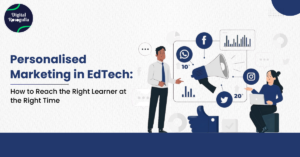
Personalised marketing in EdTech is about showing the right message, to the right person, at the right moment. It uses data, behavioural signals, and smart segmentation to make every learner feel like you understand them. In this article, we will break down exactly what personalised marketing means in the EdTech context, why it matters more than ever, and the practical strategies you can start using today.
What Is Personalised Marketing in EdTech?
At its simplest, personalised marketing means tailoring your communication to an individual based on who they are, what they have done, and what they are likely to need next. But there is an important distinction worth making here.
Basic customisation is putting someone’s first name in an email subject line. True personalisation is sending that person a message about a course in digital marketing because they spent 12 minutes on your digital marketing course page last Tuesday, abandoned the checkout, and previously enrolled in a content writing course.
True personalisation in EdTech is built on three pillars:
- Data: Understanding who your users are — their age, location, learning goals, job role, and past behaviour.
- Behaviour tracking: Knowing how they interact with your platform — which pages they visit, which courses they browse, where they drop off.
- Segmentation: Grouping users into meaningful clusters so you can speak to each group in a way that actually resonates.
Why It Matters in EdTech
Personalisation is not just a nice-to-have marketing trend. In EdTech specifically, it has a direct impact on the metrics that matter most.
Higher Engagement
When a learner receives content that feels relevant to their situation, they pay attention. A recommendation for a course that aligns with their career goals is not an interruption — it is a service. Personalised messaging consistently outperforms generic content in open rates, click-through rates, and time spent on site.
Better Conversion Rates
People enrol when they feel understood. If your marketing speaks directly to a user’s specific hesitation — whether that is price, time commitment, or course relevance — you remove friction from the decision-making process. Data-driven marketing allows you to address objections before they even surface.
Improved Student Retention
Acquiring a new student is expensive. Retaining one is far more cost-effective. Personalised nudges — like reminding a learner they are 60% through a course, or suggesting a follow-up module — keep students engaged and reduce drop-off rates, which remain a significant challenge for EdTech platforms.
Better Learning Experience
Personalisation is not just a marketing tool — it feeds into the product itself. When learners feel like a platform genuinely understands them, they trust it more. That trust translates into longer engagement, higher completion rates, and stronger word-of-mouth referrals.
Competitive Advantage
Most EdTech companies are still relying on broad, spray-and-pray marketing. The ones that invest in learner engagement through personalised, data-informed communication stand out clearly in a crowded market. It is one of the fastest ways to build a reputation for genuinely caring about your students.
Core Personalisation Strategies for EdTech
Let’s get into the practical work. These five strategies form the foundation of any solid personalised marketing approach in EdTech.
A. Data-Driven Audience Segmentation
What it is: Segmentation means dividing your total audience into smaller, more specific groups based on shared characteristics or behaviours.
How to implement it: Start by identifying the variables that matter most for your platform — role (student, working professional, parent), learning goal (career change, skill upgrade, exam prep), and stage in the funnel (new visitor, trial user, lapsed subscriber). Use your CRM or analytics tool to tag and group users accordingly.
Example: A coding platform might segment users into “freshers seeking placements”, “professionals switching careers”, and “freelancers adding a skill”. Each group receives different messaging, different course recommendations, and different pricing angles.
B. Personalised Email Marketing
What it is: Email personalisation goes far beyond using a first name. It means sending the right email at the right time based on what a user has done — or not done — on your platform.
How to implement it: Set up behaviour-triggered email sequences. A user who signs up but does not enrol within 48 hours should receive a different email than someone who completed their first module. Use tools like Mailchimp, HubSpot, or Klaviyo to automate these flows. Personalise subject lines, content blocks, and CTAs based on segment data.
Example: A learner who browsed your Python course three times without enrolling gets an email: “Still thinking about Python? Here’s what 3,000 learners said after their first week.” That specificity converts far better than a generic newsletter.
C. Website and Landing Page Personalisation
What it is: Dynamically changing what a visitor sees on your website based on who they are, where they came from, or what they have previously done on your platform.
How to implement it: Use tools like Google Optimize or simple UTM-based landing pages to show different headlines, testimonials, or CTAs to different audiences. A returning user who previously viewed design courses should land on a page featuring design content, not a generic homepage.
Example: A user arriving via a LinkedIn ad targeted at HR professionals sees: “Upskill your team without disrupting their workflow.” A student arriving from a college forum sees: “Get job-ready in 90 days.” Same platform, completely different conversations.
D. AI and Automation — Chatbots and Smart Recommendations
What it is: Using AI in education marketing means allowing algorithms to handle real-time personalisation at a scale no human team could manage manually — including chatbots that guide learners through course selection and recommendation engines that surface the next best course.
How to implement it: Deploy a chatbot on your platform (Intercom, Tidio, or a custom AI-powered bot) that asks a few onboarding questions and immediately tailors the experience. Implement a recommendation engine using collaborative filtering — “learners like you also enrolled in…” — or rule-based logic tied to user tags.
Example: A new user lands on your platform and a chatbot asks: “Are you learning for a career switch, a promotion, or personal interest?” Based on their answer, they are shown a curated learning path — not a catalogue of 500 undifferentiated options.
E. Social Media Personalisation
What it is: Social media personalisation means going beyond boosted posts and running targeted campaigns where the creative, copy, and offer are tailored to specific audience segments.
How to implement it: Use Meta’s or LinkedIn’s audience segmentation to create separate ad sets for different learner profiles. Retarget website visitors with ads that reference what they looked at. Use dynamic creative optimisation (DCO) to automatically test which combinations of headline, image, and CTA perform best per segment.
Example: Someone who visited your MBA prep course page gets a retargeting ad on Instagram: “Your MBA journey could start this month. 3,200 students already made the move.” That feels like a personal nudge, not a generic advertisement.
How to Implement Personalised Marketing: A Step-by-Step Process
Understanding the strategies is one thing. Building the system is another. Here is a clear, practical process to get started.
- Define your goals. Before touching any tool, decide what you are optimising for. Is it trial-to-paid conversions? Course completions? Re-engagement of lapsed users? Your personalisation strategy should serve a specific business objective.
- Collect audience data. Use sign-up forms, onboarding surveys, and behavioural tracking to gather first-party data. Know who your users are, what they want, and how they behave on your platform.
- Segment your users. Group users into meaningful buckets based on the data you collect. Start with 3–5 core segments and refine over time. Avoid over-segmenting early — too many segments with too little data produces noise, not insight.
- Choose the right tools. A CRM like HubSpot or Zoho, an email automation platform, a basic analytics setup (Google Analytics 4 is a solid starting point), and a retargeting tool will cover most needs. You do not need expensive enterprise software to begin.
- Create tailored content. Build different versions of your emails, ads, and landing pages for each segment. Even small differences in messaging — a different headline, a more relevant testimonial, a specific CTA — can significantly lift performance.
- Track performance. Monitor the metrics that matter for each campaign — open rates, click rates, conversion rates, and cost per acquisition by segment. Compare personalised campaigns against your previous generic benchmarks.
Optimise continuously. Personalisation is not a one-time project. Run A/B tests, update your segments as user data grows, and revisit your messaging every quarter. The more you learn about your learners, the more relevant you can become.
Best Practices to Keep in Mind
A few guardrails to keep your personalisation efforts both effective and ethical:
- Do not over-personalise. There is a line between feeling understood and feeling watched. If your messaging is too granular, it can feel intrusive. Keep personalisation helpful, not unsettling.
- Respect data privacy. Be transparent about how you collect and use data. Comply with GDPR, India’s DPDP Act, and any other applicable regulations. Build trust alongside targeting capability.
- Rely on first-party data. Third-party cookies are disappearing fast. Invest in collecting your own data through surveys, sign-up flows, and on-platform behaviour. This data is more accurate and far more durable.
- Test before you scale. Do not roll out a personalised campaign to your entire list without testing it first. Run small experiments, learn what resonates, and then expand.
- Keep messaging relevant, not just personalised. Personalisation is a vehicle for relevance. Always ask: does this message actually help this person at this moment? If not, it is still noise — just targeted noise.
Some of the brands, for whom we have created the magic for :




Conclusion
Personalised marketing in EdTech is no longer a strategy reserved for well-funded platforms with large tech teams. With the right data, a clear segmentation approach, and the tools available today, even early-stage EdTech companies can deliver experiences that feel genuinely tailored to each learner.
The impact is real: better learner engagement, higher enrolment rates, stronger retention, and a brand that learners actually trust. In an industry built on the promise of helping people grow, there is no more powerful signal than showing your audience you truly understand their journey.
The EdTech brands that will win over the next decade are not the ones with the biggest ad budgets. They are the ones that use data smartly, communicate with empathy, and treat every learner as an individual. Personalisation is how you get there.
Start small, stay consistent, and let your data guide the conversation.